Concrete driveway building in Quincy MA - water that runs away from your garage
Sinking slabs, pooling water or a surface flaking apart? We dig out, build a solid base and pour a driveway pitched to shed water.
- Fully licensed and insured.
- Free in-person estimates.
- Expect a reply within 1 business day.
What goes into building a concrete driveway in Quincy?
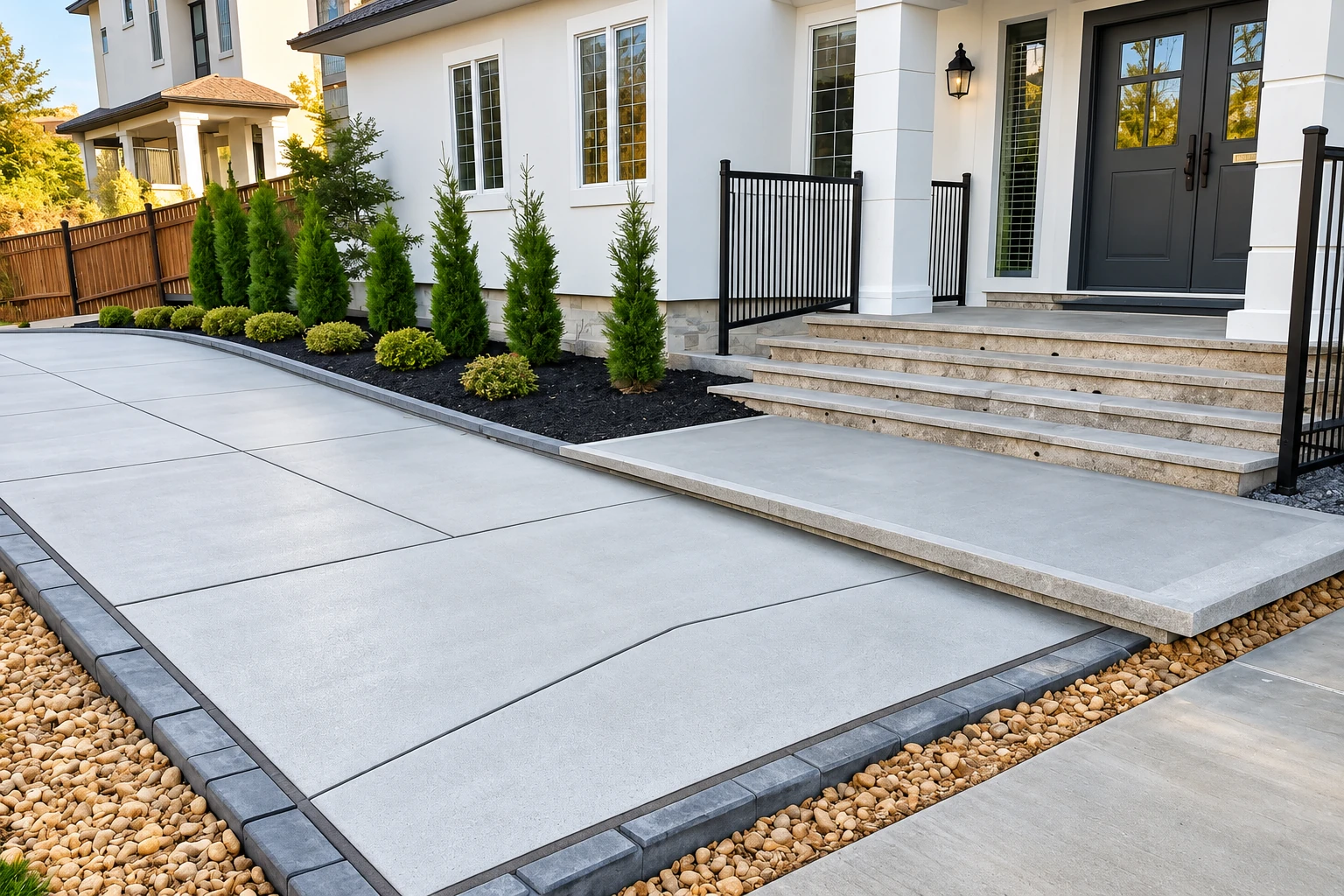
Concrete driveway building in Quincy means digging out your old driveway, building a packed base and pouring a rigid concrete slab. The slab spreads your car's weight, holds its shape in summer heat and is pitched so water runs away from your house.
Most people call us when an old asphalt or concrete driveway has sunk, cracked or started sending water into the garage. The price moves with the size, how much old surface and soft dirt has to come out, how much reshaping the slope needs and whether you park something heavy. The schedule turns on the weather and on the cure, the days the new slab needs to harden before it can take a car. When I come out, you get a written estimate that spells out everything included, so you know what you're paying for before you decide.
How do you know it's time for a new driveway?
Water running toward the garage
If rain and snowmelt run back toward the garage or pool by the door, the driveway was pitched wrong or has settled out of pitch. Every storm puts more water against the house, and in winter that puddle turns to ice right where you walk.
Sunken or tilted sections
A slab that has dropped or tipped usually sits on dirt that was raked level instead of dug out and packed, so it settled along with the ground. Water gets under the low edges and the gaps keep growing, so patches rarely hold for long.
Flaking, chipping surface
When the top layer peels off in flakes, water has usually soaked in and frozen over and over, or the top came out weak on pour day. Once the surface starts to go it keeps going, and the slab gets rougher every winter.
How we handle concrete driveway building
The first thing I settle is the slope, because a driveway has to shed water away from your garage, house and doors, and fixing a wrong pitch later means saw-cutting the slab out and pouring it again. I'll show you on site where the water will run before anything gets poured. Then our crew digs out the old driveway and the soft dirt down to firm subgrade, the ground the slab sits on, packs a base on top of it and sets the forms to that pitch. We pour in the cooler part of the day so the top doesn't dry out weak and dusty. Then we give it a broom finish and cut control joints, the grooves that give the slab a planned place to crack, before it can crack wherever it likes. If the budget gets tight, I'd rather you skip a fancy finish than skimp on the base, because nobody sees the base on day one, but it's the reason a driveway is still flat years later.
Most driveways run past other concrete, so it often makes sense to plan the rest on the same visit. If the back of the house needs a place to sit, concrete patio construction uses the same dig-out, base and slope work as your driveway. If you'd like pattern and color somewhere, stamped concrete services work well on a front walk or a border along the driveway, while the driving lanes stay broom-finished for grip.
Broom-finished slab for everyday cars
A broom finish, fine lines dragged across the wet surface, gives tires and boots grip in rain and snow, and it suits a driveway that carries ordinary cars. It's the plain, hard-wearing choice, and it leaves more of the budget for the base where it counts.
Heavier slab for trucks and trailers
Heavy loads or soft ground can call for a different design than a slab built for everyday cars, often more thickness or rebar, steel bars set inside that help hold the slab together. Tell us about the work truck, RV or boat trailer up front so the estimate is for the slab you'll actually use.
Get a written estimate for your new driveway
We reply within one business day to set a time for me to come out and measure. The estimate is free, in person and obligation-free, and it spells out what's included.
(617) 691-5008- Based in
- Quincy, MA 02169
- Hours
- Mon–Fri: 8 AM–11 PM, Sat–Sun: 7 AM–11 PM
What happens when you call about a driveway in Quincy?
Here's how a driveway job runs from your first call to the day you park on it again, and who you'll deal with at each step.
Call or send the form
We get back to you and set a time for me to come out to your house. You don't need anything decided yet, just a rough idea of what you want.
I measure and talk it through
I look at the site, measure and go over what you want, including anything heavy you'll park on it. You get a written estimate that lists what's included, so you can compare it line by line with anyone else's.
We set the date and pour
We pick a pour date with the forecast in mind, then our crew does the dig-out, base and forms before the concrete truck arrives. Plan on the driveway being out of use from the dig-out until it has cured enough to drive on.
I walk you through care
Once the pour is done, I go over how to care for the new concrete. That covers when you can park on it again and how to treat it through its first winter.
Why Quincy homeowners call Cornerstone for driveways
I measure, price and run it
I'm the one who comes out to look at your driveway and write the estimate, and I run the work with my crew of finishers and laborers. The person who showed you where the water will run is the same one standing there when the concrete goes down.
In business since 2017
I came to concrete after years in another line of work, learned it on a finishing crew under people who'd done it their whole lives, then started this business in 2017. Nine years in, I still explain every step, because a customer who understands the job asks better questions.
Coverage you can ask to see
We're fully licensed and insured, and I'm happy to show you the paperwork. The state's guidance for home improvement contractors calls itself general guidance and doesn't list a contractor registration or construction supervisor license for driveway work, so asking about insurance is a good check on anyone you hire.
Satisfaction guaranteed on every job. Call (617) 691-5008 or tell us about your driveway and I'll come out to take a look.
Building driveways in Quincy and the cities around it
I don't guess about permits. That same state guidance lists driveways as needing no building permit, but it also ties permits to the details of each project, sends you to the local building official and says to check local zoning. So before we set a date, we check with the city's building office about your driveway, and if it needs a permit, we pull it ourselves instead of handing you the paperwork.
Around Quincy we see plenty of older driveways that were laid over a raked-in base and have sunk toward the garage, so a lot of our work starts with digging out more than people expect. The pour date matters too. The American Concrete Institute counts it as cold weather when the air falls, or is expected to fall, below 40°F while new concrete still needs protecting. Concrete poured then still gains its strength if it's made, placed and protected right, but it needs more protection the colder it gets. So I watch the overnight lows for the days after a pour, not just the morning of it, and we plan the same way on jobs in Braintree and Weymouth.
Questions about concrete driveways in Quincy
How much does a concrete driveway cost in Quincy, MA?
The price comes down to your driveway's size, how much old surface and soft ground has to come out and how much base goes back in. A wider apron, a lot of regrading to fix the slope, a thicker slab for heavy vehicles or a stamped finish all raise it, while a simple broom-finished slab over firm ground keeps it down. I'll give you a written figure for your own driveway once I've measured it.
How long does a concrete driveway last compared with asphalt?
A well-built concrete driveway routinely lasts decades with little more than joint upkeep and an occasional seal, which is longer than asphalt usually holds up. Concrete costs more at the start, while asphalt costs less but needs seal coating every so often and wears out faster. If you plan to stay in the house, I'd usually lean toward concrete.
When can I drive on my new concrete driveway?
One field guide says to keep cars off a new driveway for about 7 days, and to keep heavier trucks and RVs off closer to 28 days. You can usually walk on it well before that, but plan other parking for at least the first week, because the slab is still gaining strength while it cures.
What causes lines and small cracks in a new concrete driveway?
The straight lines are the control joints, cut on purpose, and a few fine cracks are normal because concrete shrinks as it dries and moves with the temperature. Good joints steer that cracking into the grooves, where it stays tight and out of sight. Cracking can be controlled but not eliminated, so I'd be wary of anyone who promises a slab that never cracks.
What is the best way to make a concrete driveway hold up through winter?
Start with an air-entrained mix, concrete with tiny, evenly spread air pockets that relieve the pressure when soaked concrete freezes, which is what flakes the surface. Ask any contractor whether their mix has it, and we'll tell you what's in ours. An industry group's guide also says to use sand instead of deicers in the first winter, and to reapply a penetrating sealer, one that soaks in below the surface, as needed, about every 5 to 7 years.
How do I check that my contractor is pouring a thick enough driveway?
Ask how the crew checks slab thickness while grading the base, because high spots underneath can leave less concrete than was ordered. We check the depth across the base before the truck shows up, and I'm glad to show you how we do it.
Other concrete work that pairs with a driveway
Concrete patio construction
Your backyard slab faces the same questions as the driveway, where the water goes and what it sits on, so it's easy to plan both on one visit.
Stamped concrete services
If plain gray feels too bare out front, a stamped walk or border adds pattern and color, and it still goes down over a dug-out, packed base.
Where we build driveways around Quincy
Cornerstone Quincy Concrete is based in Quincy, MA, and builds driveways across the cities around it, including Milton and Canton. These are the 12 cities with their own page, and we work in others nearby too.
Quincy, MA
Send us photos of your driveway
A rough size, what's there now and a few photos of where water sits after rain let me arrive already thinking about your slope.