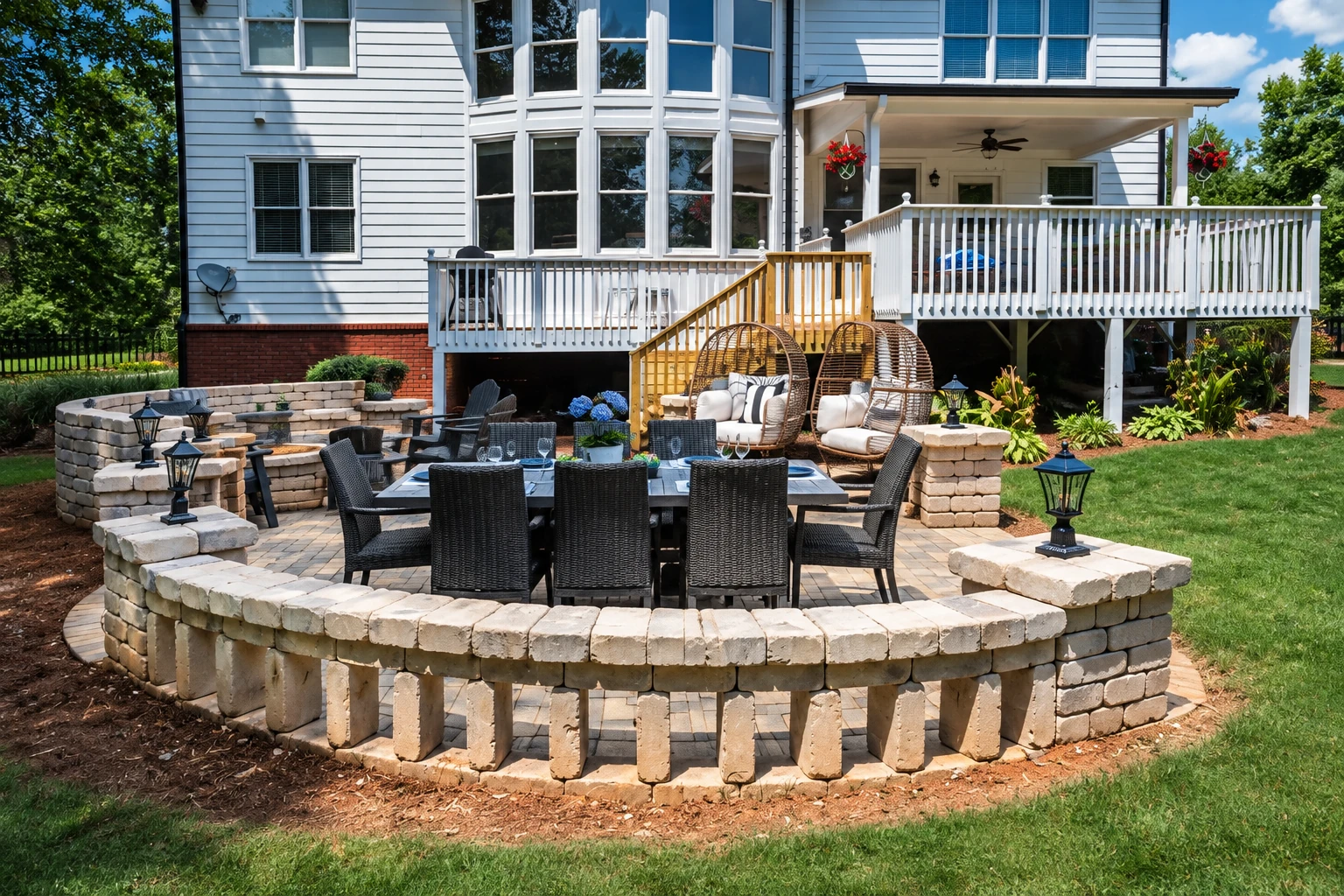
Concrete patio construction in Quincy MA - a slab built on a solid, packed base
Bare yard, sinking pavers or a cracked old slab out back? We build a concrete patio that starts with the ground under it.
- Fully licensed and insured.
- Free in-person estimates.
- Expect a reply within 1 business day.
What does it take to build a concrete patio in Quincy?
Concrete patio construction in Quincy, MA means digging out part of your yard, building a packed gravel base and pouring a finished slab for your table and grill, then giving it time to cure before you use it. Most of the job, and most of what decides how it holds up, happens before the concrete truck shows up.
Most patio calls start with a patch of worn lawn by the back door or an old slab that's sunk and cracked. The price mostly comes down to the size, how much digging and base the ground needs, whether an old patio has to be broken out and hauled off, how easily we can get concrete to the spot, and whether you want a plain finish or stamped concrete. The schedule turns on the weather more than anything, since we only pour when the days after look right. If the job needs a permit, we pull it ourselves, and your own number comes in a written estimate that spells out what's included.
How do you know your old patio is past fixing?
Slab tipping toward the house
If rain runs toward your back wall instead of away from it, the ground under the slab has usually settled or washed out. Every storm you wait puts more water against your foundation, and the slab keeps dropping.
Wide cracks with raised edges
A hairline crack is normal, but a crack you can catch a toe on, with one side higher than the other, usually means the base moved. Patching the crack doesn't fix the ground, so it tends to open back up and turn into a tripping spot.
Surface flaking off in patches
Pitted spots where the top layer has peeled away usually come from freezing water and salt working on a weak surface. It spreads a little more each winter, and past a certain point patching rarely looks or holds right.
How we handle concrete patio construction
A patio is a slab sitting on the ground, so the ground does most of the work, and if the base is poor, no amount of steel in the slab will save it. That's why most of our effort goes there. I start by marking out the patio with you and showing you where the control joints will go, the straight grooves we cut so the slab cracks along a line we picked instead of one it picks for itself. Then we dig out the sod and soft topsoil down to firm subgrade, the native ground everything sits on, check which way the water runs so the finished slab sheds it away from your house, and bring in gravel that we spread and pack in layers rather than just rake level. Forms go up, and rebar goes in, steel bars that hold any cracks tight. We pour early in the day so the top doesn't bake in the afternoon heat and turn weak and dusty later, give it a broom finish, a light swept texture that keeps it from getting slick when it's wet, cut the joints while the concrete is still young, and keep it moist while it cures, the slow hardening that sets how strong the surface ends up. If the budget gets tight, I'll steer you toward spending it on the base before the finish, because the base is the part you'll never see again and the part that decides whether the slab stays put.
Patios rarely stand alone. Plenty of people want a pattern or color on top, and our stamped concrete services go on the same packed base. A concrete sidewalk from the driveway or back steps out to the patio is often worth pouring at the same time, since the crew and the truck are already there.
Plain broom-finished slab
This is what most people pick for a grill and a table, because it gives good footing and costs the least per square foot. It also leaves more of the budget for the base, which is where I'd rather see it go.
Stamped or colored surface
This suits you if you want the look of stone or brick without the loose pieces that shift and grow weeds. It costs more because the finishing takes extra hands and time on pour day.
Replacing an old patio
If your current slab or pavers have sunk, we break them out, haul them away and dig out whatever soft fill let them drop. Tear-out adds to the job, but building on top of a failed base just repeats the problem.
Get a written estimate for your new patio
Send us the rough size in square feet and when you'd like it. We reply within one business day to set a time for me to come out, and the written estimate is free with no obligation.
(617) 691-5008- Based in
- Quincy, MA 02169
- Hours
- Mon–Fri: 8 AM–11 PM, Sat–Sun: 7 AM–11 PM
What happens after you call about a patio in Quincy?
Here's how a patio job runs from your side, from the first call to the day I hand it back with care instructions.
Call or send us the form
We get back to you and set a time for me to come out. Tell us roughly where the patio goes and anything you're unsure about, so I know what to look at.
I visit, measure and price
I look at the ground, the drainage and how we'll get concrete back there, then talk through what you want. You get a written estimate that spells out what's included, so you can compare it line for line with anyone else's.
We pick a date and pour
We set the pour date with the forecast in mind, then dig out, build the base and pour. Expect the crew in your yard and the truck at the curb on pour day.
I walk you through care
Once it's finished, I walk the patio with you and go over how to look after it while it cures and through its first winter. That's also the time to ask anything, and I'd rather you did.
Why Quincy homeowners call us for patios
I write every estimate myself
I'm the one who comes out, looks at your yard and writes the estimate, and I run the work with my crew of finishers and laborers. The person who answered your questions is the one on site making sure it's built the way we talked about.
Nine years of patios and walks
We've been in business since 2017, and patios, walks, steps and driveways are what we're best known for. I learned the trade on a finishing crew under people who'd poured concrete their whole lives, and their habits are the ones we still work by.
Licensed and insured beyond the minimum
Massachusetts contractor guidance lists patios as work that generally needs no construction supervisor license or home improvement contractor registration, depending on the project. We're fully licensed and insured all the same, so you're not the one carrying the risk while a crew works in your yard.
Explained first, guaranteed after
Before anything gets poured, I walk you through the base, the joints and the cure, so you know what you're paying for and can ask sharp questions. We back the work with one promise, satisfaction guaranteed on every job.
With a patio, the work that counts most is the work buried under it on pour day. If you'd like to talk yours through, send us the details or call (617) 691-5008.
Patios, permits and wet ground in Quincy
That same state guidance lists patios as work that generally doesn't need a building permit, but it says the answer depends on the project and to check with the local building official, so we don't assume. I check with the building office before we set a date, and if your patio does need a permit, we pull it ourselves. Water is the other local check. Quincy sits on Boston Harbor and Quincy Bay, and Marina Bay, Wollaston Beach and Germantown have a lot of flood-prone ground. The state's wetlands law protects land that floods as well as wetlands, and it covers work like regrading, which digging out for a patio can count as. If your yard is in one of those areas or within 100 feet of a wetland, the strip the state calls the buffer zone, you'll need to contact the conservation commission before any digging starts, and I'll ask about it at the estimate so it doesn't catch us by surprise.
Around Quincy we see a lot of tight backyards behind older houses, so concrete often goes back by wheelbarrow or pump instead of straight off the truck, and digging sometimes turns up old fill or buried stone that has to come out before the base goes in. We run into the same things on jobs in Braintree and Weymouth, and we work across the cities around Quincy, including those on our city pages and others nearby.
Questions about concrete patios in Quincy
How much does a concrete patio cost near Quincy, MA?
A concrete patio in the Boston area usually costs about $6 to $15 per square foot, materials and labor included. That's the going market range around here, not a quote from us. Where yours lands depends on the digging and base your yard needs, any tear-out, access and the finish, and your written estimate gives your actual number with everything spelled out.
When is the best time of year to pour a concrete patio in Massachusetts?
The best time is a stretch when no freeze is expected soon after the pour. Concrete industry guidance urges caution about pouring outdoor slabs in late fall, winter or early spring if freezing weather is likely to follow while the new concrete is still saturated. That's why I set pour dates by the forecast and not just the calendar.
Will my new concrete patio crack?
Probably a little, and that's normal. Even a well-designed slab poured right isn't crack-free, and an honest contractor should tell you that before the job, not after. The control joints give those cracks a straight, planned line to follow and help keep random wide ones from forming, so a hairline crack sitting in a joint means the joint is doing its job.
What causes a concrete patio to flake after winter?
Flaking, called scaling, usually comes from freezing water and deicing salt working on the top layer, and it's less likely with dense, air-entrained concrete, careful installing and curing, and light use of deicers. Air-entrained concrete has tiny bubbles mixed in that give freezing water room, which is also why a finisher shouldn't overwork the surface and knock that air out of the top. When you compare estimates, ask what mix goes in and how the slab will be cured.
What is the best way to protect a new concrete patio in its first winter?
Keep salt and other deicers off it the first winter, then use them in moderate amounts after that. Shoveling is the safer way to keep it clear that first season. It's one of the things I go over with you when I hand the patio back.
How do I seal a new concrete patio?
Concrete industry guidance suggests a breathable silane or siloxane based sealer or water repellent made for concrete slabs, put on once the slab is reasonably dry. The same guidance points to late summer, after a few dry days, as an ideal time to apply it. If your patio goes in during spring, that usually means sealing it later the same year.
Concrete work that pairs well with a patio
Stamped concrete services
If plain gray concrete feels too bare next to your house, a stamped pattern and color can give your patio the look of stone or brick.
Concrete sidewalk building
A patio you have to reach by crossing wet grass gets used less, so a poured walk from the driveway or back steps ties it in.
Cities we serve around Quincy
Cornerstone Quincy Concrete is based in Quincy, Massachusetts, and we build patios across the cities around it, from Milton to Canton. The 12 cities below have their own pages, and they aren't the only places we work.
Quincy, MA
Tell us about the patio you want
Call (617) 691-5008 or use the form with your rough patio size, your timing and whether you're near the shore or a wetland, so the first visit can cover everything.